
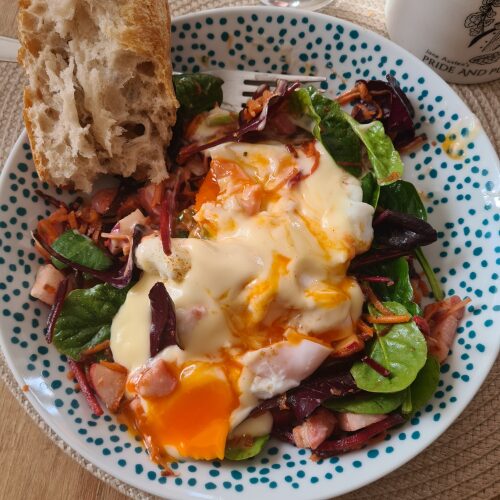
Poached Eggs with Bacon, Carrot & Hollandaise
Ingredients

 4 Eggs
- 75 g Bacon lardons
 1 Carrot
- 50 g Bistro salad
- 6 tbsp Hollandaise sauce
- White vinegar
 Salt
Salt- Pepper
 Bread (optional)
Instructions
Prepare the ingredients
- Peel the carrot and grate it coarsely using a box grater. Set aside.
- Place a small frying pan over a medium heat. Add the bacon lardons and fry for 4-6 minutes, stirring occasionally, until they are crisp and golden. Remove with a slotted spoon and drain on kitchen paper. Keep warm.
Poach the eggs
- Fill a wide, shallow pan or deep frying pan with water to a depth of about 5-8cm. Bring to a gentle simmer, then add a splash of white vinegar (this helps the egg whites set).
- Crack each egg into a small ramekin or cup.
- Stir the simmering water gently to create a gentle whirlpool, then carefully slide one egg into the centre. Repeat quickly with the remaining eggs, but do not overcrowd the pan.
- Poach for 2-3 minutes for runny yolks, or 4 minutes for firmer yolks. Using a slotted spoon, remove each egg and drain briefly on kitchen paper. Season lightly with salt and pepper.
Assemble the salad:
- Divide the Bistro salad leaves between two plates. Scatter the grated carrot over the salad leaves.
- Sprinkle the crispy bacon lardons over the top. Carefully place two poached eggs on each plate, nestled on top of the salad.
- Spoon the hollandaise sauce generously over the eggs. Finish with a final crack of black pepper and serve straight away, with crusty bread on the side if desired.
Notes
FAQs
How do I know my eggs are fresh enough for poaching?
Fresh eggs are non-negotiable for poaching. The whites hold together tightly around the yolk, rather than spreading into wispy strands. To test, place an egg in a bowl of water: a fresh egg will sink and lie flat on its side; an older egg will stand upright or float.
Why add vinegar to the poaching water?
The acid in vinegar helps the egg white proteins coagulate (set) more quickly, forming a neat, compact shape around the yolk. It is especially helpful if your eggs are not at peak freshness. Do not use too much—a splash per litre is enough.
What is the whirlpool technique, and is it necessary?
Stirring the water to create a gentle whirlpool helps the egg white wrap around itself and the yolk, resulting in a neater, more gathered shape. It’s a useful trick but not essential, especially if you are poaching multiple eggs. Fresh eggs and the right temperature are more important.
How long should I poach the eggs for a runny yolk?
For a perfectly runny, jammy yolk, poach for exactly 3 minutes. For a slightly firmer but still soft yolk, go for 4 minutes. The timing starts from the moment the egg hits the water. Remember to remove them with a slotted spoon and drain well.
Can I use homemade hollandaise, and do you have a quick version?
Absolutely, homemade hollandaise elevates this dish. For a quick, foolproof version, use an immersion blender: melt 150g butter. In a tall beaker, blend 2 egg yolks, 1 tbsp lemon juice, salt, and cayenne. With the blender running, slowly drizzle in the hot butter until thick and creamy.
The recipe uses ready-made hollandaise. Is that acceptable?
This bistro-style salad is designed for accessibility. A good-quality, ready-made hollandaise (from a jar or sachet) is perfectly acceptable for a quick, delicious meal. It delivers the classic flavour without the stress of making the sauce from scratch for a weekday lunch.
Can I prepare any of the components ahead of time?
Yes. You can cook the bacon lardons and grate the carrot in advance. Poached eggs can be made an hour ahead: plunge them into a bowl of ice-cold water immediately after cooking to stop the process, then reheat in barely simmering water for 30-60 seconds before serving.
Can I make this vegetarian?
Easily. Omit the bacon. For a smoky, savoury element, you can add a sprinkle of smoked paprika or a few sautéed mushrooms alongside the salad. Ensure your hollandaise is vegetarian (some contain gelatine or are made with non-vegetarian rennet in the butter; this is rare but check).
What type of salad leaves work best?
Use a mix of bitter and peppery leaves for a classic bistro salad. Frisée (curly endive) adds texture, rocket (arugula) adds peppery bite, and lamb’s lettuce (mâche) or little gem adds softness. The combination balances the richness of the eggs and sauce.
Why grate the carrot instead of slicing it?
Grated carrot provides a tender, delicate texture that blends seamlessly with the soft salad leaves, rather than chunky slices that would compete. It also distributes more evenly throughout the dish, adding sweetness in every bite.





Throw in your flavor